
How to Plan a Corporate Headshot Session in Chicago
Organizing professional headshots for an entire company requires more planning than a single portrait session. This guide walks the organizer through every step, from defining the visual direction to scheduling participants and planning for future employees.
Organizing a headshot session for one executive is relatively straightforward. Organizing consistent professional photographs for an entire company or team requires considerably more planning.
Before anyone steps in front of the camera, the organizer may need to answer questions such as: What are the photographs for? Who needs to be photographed? What should the images look like? Where will the session take place? Who is the photographer? How will employees be scheduled? What should participants wear? What files need to be delivered? How will future employees match the existing photographs?
A successful corporate headshot session begins before production day. This guide walks the organizer through that process.

Step 1: Decide Where the Headshots Will Be Used
This is the first planning decision, and it influences nearly every other one.
Potential uses may include the company website, team directory, leadership pages, LinkedIn profiles, speaker profiles, press materials, email signatures, sales materials, recruiting materials, internal communications and professional biographies.
Intended use can influence composition, crop, orientation, background, wardrobe guidance and file requirements. A headshot used primarily as a small circular profile image has different requirements than a full-width leadership portrait on a company website.
Identify all expected uses before the session, not after.
Step 2: Determine Who Needs a Headshot
Build a participant list before building the schedule.
Potential groups might include executives, leadership, the sales team, customer-facing employees, the entire staff, new employees or specific departments. The organizer should know who is participating, who has confirmed, who still needs scheduling and whether anyone requires additional time or accommodation.
A simple roster maintained before and during the planning process can prevent scheduling gaps on production day.
Step 3: Establish a Consistent Visual Direction
When photographs will appear together on a company team page, leadership page, marketing materials or directory, visual consistency matters.
The company should decide on broad visual direction before production. Potential decisions include light or dark visual direction, neutral or colored background, tight headshot or wider portrait, formal or more relaxed presentation, similar crop across participants, horizontal or vertical orientation and whether full-body images are required.
There is no single correct corporate style. A law firm, technology company, creative agency and restaurant group may intentionally choose very different visual directions. The important factor is intentional consistency within the organization's chosen approach.
Step 4: Create a Headshot Reference
Before photographing a large group, the company and photographer should establish a reference image or visual guideline.
A reference can help define background, crop, camera angle, subject position, general lighting direction, amount of negative space, intended expression and overall visual tone.
A reference is particularly valuable if employees will be photographed over multiple days, new hires will be photographed later, multiple offices are involved or the company expects to update headshots over time. It does not guarantee exact replication between separate sessions, but it gives future productions a starting point.
Step 5: Choose the Photographer
Studio 33 provides the rental environment. The organizer should separately determine who will photograph the session.
When selecting a photographer, companies may want to review relevant portfolio work, experience with professional portraits, ability to create the desired visual style, production workflow, file delivery process, retouching approach, usage terms and scheduling requirements.
Step 6: Studio or Office Location?
A company may choose to photograph employees at its office, at another company location or in a professional photography studio.
An office or company location may be appropriate when employees are already gathered there, the workplace is part of the desired image, environmental portraits are required or moving participants is impractical.
A studio may be appropriate when the production benefits from a dedicated shooting space, controlled background, planned lighting, preparation area, separation from normal workplace activity or a consistent shooting environment.
Neither is universally better. For a broader comparison of the two approaches, see Photo Studio vs. Location Shoot: Which Is Right for Your Production?
Step 7: Think About the Background
Background selection should support the intended use and brand direction.
General approaches include white, light neutral, dark neutral, brand-inspired color and environmental background. These are general approaches, not a complete inventory of what any specific studio provides.
Studio 33 has a 14' x 14' white cyclorama wall. A white cyclorama can provide a clean environment for professional portrait photography. However, a white cyc does not automatically photograph as pure white. Its final appearance depends on lighting, exposure, subject position, camera settings, production choices and post-production. For a full explanation, see What Is a Cyclorama Wall? A Guide for Chicago Photographers.

Step 8: Consider Brand Color and RGB Lighting
Some organizations may want a more distinctive visual direction than a traditional neutral headshot.
Color may potentially be incorporated through background treatment, lighting, wardrobe or graphic design after photography.
Studio 33 has three RGB panels positioned on the ceiling lighting grid and one additional panel on a C-stand. RGB lighting can potentially introduce colored backgrounds, gradients, brand-inspired visual treatments and creative portrait environments. Exact HEX, Pantone or corporate color reproduction is not guaranteed. A traditional neutral portrait may be more appropriate for some organizations.
For creative examples, see RGB Lighting Ideas for Portrait Photography and the RGB lighting studio page.
Step 9: Create Simple Wardrobe Guidance for Employees
One of the most useful things an organizer can do is communicate wardrobe expectations before production day.
Avoid rigid universal rules. The company should decide what level of presentation matches its brand, industry, workplace, intended audience and visual direction. Potential guidance might address formality, company-branded apparel if appropriate, broad color direction, whether jackets or ties are expected, whether multiple looks are needed and whether full-body photographs are planned.
Consistency does not require everyone to wear identical clothing. For detailed wardrobe guidance to share with participants, see What to Wear for a Professional Photoshoot. If some employees need more than a standard headshot — wider portraits, multiple looks, or content designed for personal marketing — see How to Plan a Personal Branding Photoshoot for guidance on planning that broader type of session.
Step 10: Build a Realistic Headshot Schedule
Do not create a schedule using an arbitrary universal number of people per hour.
The amount of time required per person depends on the photography approach, number of images, number of looks, wardrobe changes, review process, individual preparation, photographer workflow and any additional video or content requirements.
Work with the photographer to determine the expected production workflow, then build the employee schedule around that process. Include reasonable transition time between participants.
Step 11: Avoid Creating a Waiting-Room Problem
Bringing everyone at once may not be appropriate for every session.
Depending on the production, organizers may consider appointment windows, small groups, department blocks or individual time slots. The goal is to coordinate participant flow with the photographer's actual workflow rather than creating a backlog of employees waiting with nothing to do.
Step 12: Give Employees Instructions Before the Session
Send a concise pre-session message containing the date, location, arrival instructions, assigned time, wardrobe guidance, whether a wardrobe change is expected, the intended photograph style, a relevant company contact and any preparation instructions provided by the photographer.
For Studio 33 sessions, organizers can provide the verified address: 33 N. Addison Rd., Addison, IL 60101. Free on-site parking is available.
Step 13: Use a Green Room for Preparation
A separate preparation area can be useful during a multi-person headshot session.
Studio 33 has a private green room with two vanity stations, a large sofa, a wardrobe rack, a privacy divider and device chargers. The area can support personal preparation, wardrobe organization, changing, waiting between scheduled photographs and keeping personal belongings separate from the main shooting area.
Makeup artists, hair services, wardrobe and styling are not included with the rental.

Step 14: Decide Whether Everyone Needs the Same Deliverables
Not every company needs exactly the same output for every employee.
Leadership may require a website portrait, speaker image, press photograph and a wider branding portrait, while other employees may only require a standard company headshot. This is one example, not a prescription.
Identify deliverables before production so the photographer knows what must be captured during the session.
Step 15: Consider Photography and Video Together
Some companies may want to use the production day for more than headshots.
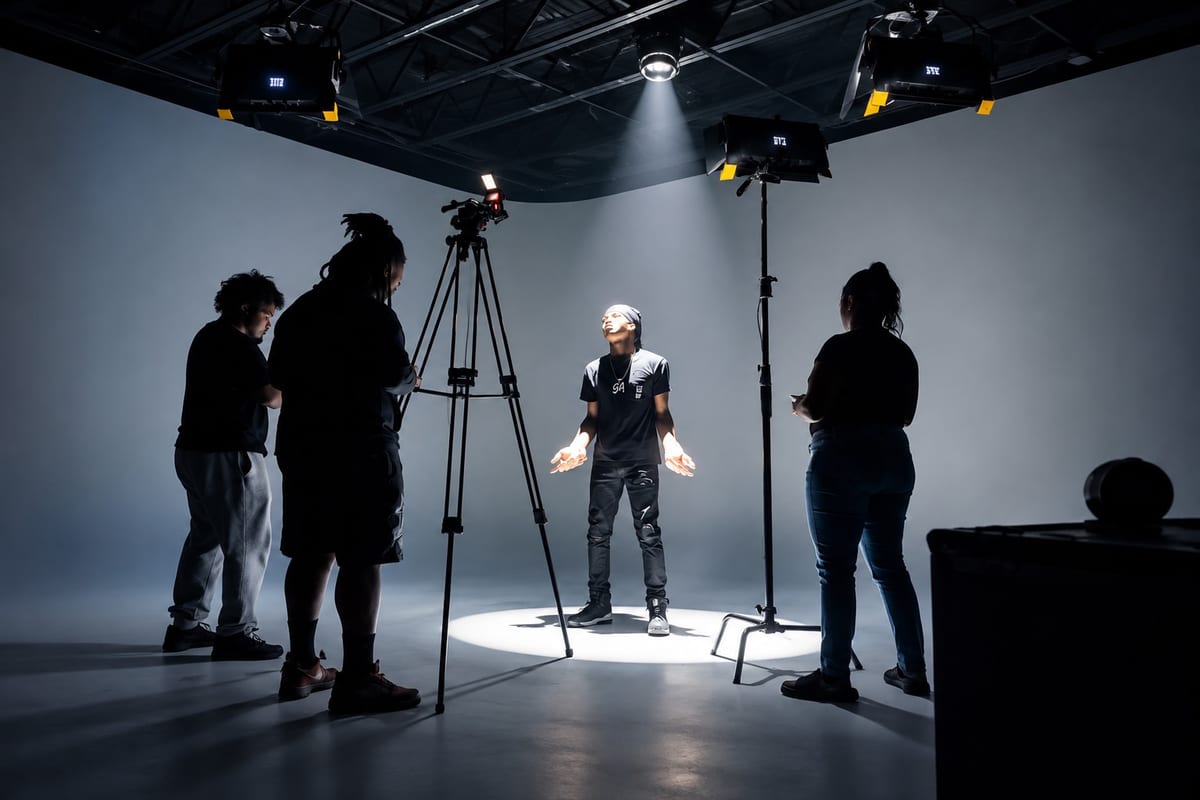
Potential additional content may include leadership video, employee introductions, short interviews, recruiting content, company messages and b-roll. If video is planned, identify it before booking because it may affect equipment, scheduling, audio, lighting, rental time and participant preparation.
Studio 33 provides an environment suitable for photography and video production. Studio 33 should not be described as soundproof or acoustically treated. For spoken audio, production teams should evaluate the environment for their specific requirements and arrange appropriate audio equipment. See the video studio rental page and How to Plan a Professional Video Interview in a Studio for guidance.
Step 16: Determine How Much Studio Time You Need
Rental time should account for more than the minutes employees spend in front of the camera.
Potential production time includes arrival, load-in, camera setup, lighting setup, testing, participant preparation, photography, transitions, wardrobe changes, additional portraits, video if applicable, review, breakdown and load-out.
Work backward from the number of participants, photographer workflow, deliverables, setup requirements, transitions and breakdown time to arrive at a realistic total. For a detailed planning guide, see How Long Should You Rent a Photo Studio? For a broader look at everything to evaluate before booking a studio for a multi-person production, see the complete guide to renting a photo studio in Chicago.
Step 17: Plan the File and Approval Process Before the Shoot
Understand how photographs will move from production to final delivery before the session takes place.
Questions to resolve with the photographer may include: Who selects the final images? Does each employee select, or does the company select? What retouching is included? What file formats are delivered? What crops are required? How are files named? Who receives the files? What usage rights apply? How are future employee photographs handled?
Studio 33 does not automatically provide editing, retouching or file delivery.
Think Beyond the First Headshot Day
Companies change over time. New hires join, leadership changes, rebranding happens, website redesigns require updated photography.
Encourage organizations to document the visual approach used for the original headshots. Useful information might include background, general crop, visual reference, photographer, wardrobe guidance, general lighting direction and file specifications. This can help future sessions aim for visual continuity without requiring a complete restart.
Common Corporate Headshot Planning Mistakes
- Booking before defining the required images
- Failing to create a complete participant list
- Giving employees little or no wardrobe guidance
- Assuming everyone can arrive simultaneously
- Forgetting setup and breakdown time
- Choosing a background without considering the company website or brand
- Failing to plan for future employees
- Assuming the studio rental automatically includes a photographer
- Waiting until after the session to decide what files are needed
- Adding video at the last minute without adjusting the production plan
Planning Corporate Headshots at Studio 33 Chicago
Studio 33 Chicago is a professional photo, video and content production studio located at 33 N. Addison Rd. in Addison, Illinois, serving photographers, businesses, brands, agencies and production teams throughout Chicago and the surrounding western and northwestern suburbs.
The studio provides an environment that can be used for appropriately planned corporate headshot and business portrait productions.
Verified features include:
- 14' x 14' white cyclorama wall
- Professional ceiling lighting grid providing flexible overhead lighting positions
- RGB lighting (three ceiling-grid panels and one C-stand panel)
- Private green room with two vanity stations, large sofa, wardrobe rack, privacy divider and device chargers
- High-speed Wi-Fi
- Climate-controlled studio
- Men's and women's restrooms
- Free on-site parking
- Sandbags and apple boxes
- Photography and video production capabilities
Studio rental starts at $105 per hour, subject to current minimum booking requirements:
- Monday through Friday daytime: 2-hour minimum
- Evenings: 3-hour minimum
- Weekends: 3-hour minimum
The rental provides the studio environment. Photographers, videographers, cameras, lenses, makeup artists, hairstylists, wardrobe stylists, retouching, editing and finished photographs are not included.
Corporate Headshot Session Planning Checklist
Before booking:
- Determine where the headshots will be used
- Build the participant list
- Determine required deliverables
- Establish the visual direction
- Determine background requirements
- Decide studio versus company location
- Select the photographer
- Determine whether video is also needed
- Estimate production time
- Confirm studio availability
- Review pricing and minimum booking requirements
Before production day:
- Finalize participant schedule
- Send employee instructions
- Send wardrobe guidance
- Confirm photographer
- Confirm equipment requirements
- Confirm background and visual direction
- Prepare a reference image if appropriate
- Confirm shot list
- Confirm any leadership-specific deliverables
- Confirm video requirements if applicable
- Confirm file-selection workflow with the photographer
- Confirm studio address and arrival information
- Allow time for setup and breakdown
After the session:
- Confirm image selection process
- Confirm final file requirements
- Organize files consistently
- Maintain a reference for future employee headshots
Frequently Asked Questions About Corporate Headshots
How do you organize a corporate headshot day?
Start by determining the purpose of the photographs, participants, deliverables and visual direction. Then select the photographer and location, establish wardrobe guidance, create a participant schedule and confirm the file-delivery process.
How long should a corporate headshot session take?
There is no universal answer. The required time depends on the number of participants, photographer workflow, number of looks, deliverables, setup requirements, transitions and whether additional photography or video is being created.
What should employees wear for corporate headshots?
Wardrobe should reflect the company's professional environment, brand and intended use of the photographs. There is no universal requirement to wear suits, blazers, solid colors or any particular color. Provide participants with clear guidance before the session.
Should corporate headshots all have the same background?
Not necessarily. However, when employee photographs will appear together, a consistent visual direction can help create continuity. That may include a consistent background, crop, composition or other visual elements.
Should corporate headshots be taken in an office or studio?
Either can work. An office can provide environmental context and convenience for employees. A professional studio may provide a dedicated shooting environment, controlled background, planned lighting and preparation space. Choose based on the production requirements.
How many employees can be photographed per hour?
The photographer's workflow, required images, review process, participant preparation and other production requirements determine realistic scheduling. There is no universal number.
Does Studio 33 provide the headshot photographer?
Studio 33 is primarily a professional studio rental environment. Companies should arrange the photographer and other professionals required for their production unless current booking information states otherwise.
Can Studio 33 be used for executive portraits as well as employee headshots?
Yes. Studio 33 provides a photography environment that can be used for appropriately planned professional headshots, executive portraits, personal branding photography and other business portrait productions. Photography services are not included.
Where is Studio 33 Chicago located?
Studio 33 Chicago is located at 33 N. Addison Rd. in Addison, Illinois, serving Chicago and the surrounding western and northwestern suburbs.
Plan the Headshot System, Not Just the Headshot Day
A corporate headshot session should not be viewed only as a series of individual portraits. For an organization, the larger goal is to create a repeatable visual system.
That system includes purpose, visual direction, background, composition, wardrobe guidance, participant scheduling, photographer workflow, file standards and a plan for future employees. When those decisions are made before production day, the company and photographer have a clearer framework for creating the required images.
Businesses, agencies and photographers looking for a Chicago-area environment for corporate headshots and business portraits can explore Studio 33's photo studio rental, cyclorama wall, RGB lighting, green room, studio amenities and gallery pages to see whether the space fits the production.